Ingredients
- 1 cup (200 g) dried whole mung beans
- 3 large eggs
- 1 teaspoon baking powder
You will also need:
- A large bowl, for soaking
- A high-powered blender
- An 8 × 4-inch (20 × 10 cm) loaf pan
- Parchment paper
- A wire cooling rack
🧂 Ingredient Notes and Smart Substitutions
Dried whole mung beans
Use dried whole mung beans, the small green ones that still have their skins. They are different from split and peeled mung beans (moong dal), which are yellow and have no skin. Whole mung beans need a long soak and blend into a speckled green-beige batter. Look for beans that are uniformly green, dry, and free of debris, and rinse them thoroughly before soaking.
Substitution: Split yellow mung beans (moong dal) soak faster and blend smoother, but this recipe is written for whole mung beans, so the texture and soaking time may differ. If you use them, soak for a shorter time and blend until very smooth.
Large eggs
Three large eggs provide the binding, structure, and lift. Use eggs at room temperature if you can, because they blend more smoothly into the batter. Because the batter contains raw eggs, bake the loaf until fully set.
Baking powder
A teaspoon of baking powder helps the loaf puff slightly and keeps the crumb from being too dense. Make sure it is fresh. If it has been open for more than 6 months, test it by stirring ½ teaspoon into hot water. It should fizz right away.
Water (for soaking and blending)
Plenty of water is needed for the long soak, because the beans will expand as they absorb water. A small splash of water may be added during blending, only as needed, to help the blender move the batter.
Optional flavor additions
The recipe uses three main ingredients, so the flavor is mild. As your recipe notes, you can add garlic powder, dried rosemary, black pepper, or a pinch of salt for a savory loaf. These are optional additions beyond the three main ingredients.
Instructions
Rinse the dried mung beans thoroughly under running water. Place them in a large bowl, cover with plenty of water, and soak for 8 to 12 hours or overnight. The beans will expand as they absorb water.
Tip: Use a bowl large enough to hold the beans plus at least 3 to 4 times their volume in water, as they swell considerably. Start the soak in the evening, so the beans are ready in the morning. In a very warm kitchen, soak in the refrigerator to prevent fermentation.
Drain the soaked beans completely and rinse them again. Remove any loose skins if desired, although this is not necessary.
Tip: Draining well is important, because extra water can make the loaf overly moist and dense. Shake the colander well, and let the beans sit for a minute or two to drain.
Add the soaked mung beans and eggs to a high-powered blender. Blend until the mixture is as smooth as possible. Add the baking powder and pulse briefly to combine. The batter should be thick but pourable. If your blender struggles, add a small splash of water only as needed.
How to tell it is ready: The batter should look like a thick pancake or cake batter, with no large pieces of bean left. A few tiny flecks of skin are fine. Blend longer if it feels gritty.
If your blender is not very powerful: Blend in short bursts, stopping to scrape down the sides. A smoother batter gives a better loaf, so be patient.
Preheat the oven to 350°F (175°C). Line a small loaf pan, approximately 8 × 4 inches (20 × 10 cm), with parchment paper or grease it lightly. Parchment with a little overhang makes it easy to lift the loaf out.
Transfer the mixture into the prepared pan and gently tap the pan on the counter to release large air bubbles. Smooth the top with a spatula.
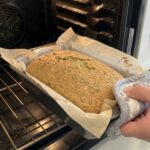
Bake for 40 to 50 minutes, or until the loaf is firm in the center and a toothpick inserted into the middle comes out without wet batter. If the top browns too quickly, loosely cover it with foil.
Doneness tip: The center should feel firm when pressed, and the edges should pull slightly from the sides of the pan. Because the batter contains raw eggs, never slice into a loaf that is still wet in the middle. Give it extra time if needed.
Remove the loaf from the oven and let it rest in the pan for 10 minutes. Transfer it to a wire rack and allow it to cool completely before slicing. This helps the texture firm up.
Cut into slices and enjoy fresh or lightly toasted. Pair with avocado, cottage cheese, eggs, hummus, or your favorite sandwich fillings! 🥑🍳
Slicing tip: Use a serrated knife and a gentle sawing motion. Slicing while hot may cause the bread to crumble or appear gummy.
When soaked, mung beans absorb water and soften. Blended into a batter and heated, their starch swells and sets, forming the body of the loaf. This is similar to how flour sets in a quick bread.
The egg proteins coagulate as they bake, firming into a network that holds the loaf together. Air whipped in during blending expands in the oven, giving a gentle lift.
The baking powder releases gas when it meets moisture and heat, creating tiny air pockets that keep the crumb tender rather than dense.
As the loaf cools, the starch and proteins finish setting. Slicing too soon cuts into a loaf that is still firming up, which is why cooling completely makes such a difference.