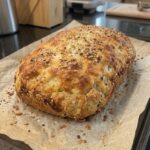
Ingredients
For the bread:
- 1½ cups cottage cheese
- 2 large eggs
- 1½ cups self-rising flour
- ½ cup shredded cheddar cheese
- 2 tablespoons dried minced onion
- 1 teaspoon onion powder
- ½ teaspoon garlic powder
- ½ teaspoon salt, or to taste
- 1 tablespoon chopped fresh chives (optional)
- 1 to 2 tablespoons milk, only if needed
Optional topping:
- 1 tablespoon everything bagel seasoning
- 1 tablespoon extra shredded cheese
- A few dried onion flakes
Ingredient Notes and Smart Swaps
Cottage cheese. Full-fat or 2% cottage cheese gives the best flavor and moisture. Low-fat versions work too, but the loaf may be slightly less rich. Small-curd and large-curd both work. Blending is optional but gives a smoother crumb. If your cottage cheese is very watery, drain off excess liquid first so the batter doesn’t turn out too wet.
Eggs. Large eggs bind the batter and add structure and protein. Bring them to room temperature if you can, so they blend smoothly.
Self-rising flour. Self-rising flour already contains baking powder and salt, which is what lifts the loaf without yeast. If you don’t have it, make your own: for each cup of all-purpose flour, whisk in 1½ teaspoons of baking powder and ¼ teaspoon of salt. For this recipe, that means 1½ cups all-purpose flour, about 2¼ teaspoons baking powder, and a generous ⅓ teaspoon of salt. Reduce the added salt slightly if you want to be cautious.
Cheddar cheese. Sharp cheddar gives the strongest flavor. Shredding your own from a block melts better than pre-shredded cheese, which often contains anti-caking agents. Swap in Monterey Jack, Gruyère, or Parmesan for a different profile.
Dried minced onion. This provides the signature onion bagel flavor and texture. Rehydrating it briefly in the milk or a spoonful of water can soften it, but it also hydrates in the batter during baking.
Onion powder and garlic powder. These round out the savory flavor evenly throughout the loaf.
Salt. Because self-rising flour and cheese already contain salt, start with the suggested amount and adjust to taste next time.
Chives. Fresh chives add a mild, fresh onion note and a pop of green. Scallion greens work as a substitute.
Milk. Add a tablespoon or two only if the batter looks too thick and dry. The finished batter should be thick and slightly sticky, closer to a thick muffin batter than a pourable cake batter.
Everything bagel seasoning. The classic topping blend of sesame seeds, poppy seeds, dried garlic, dried onion, and salt gives the loaf its unmistakable bagel-shop look and flavor.
Instructions
- A large mixing bowl
- A whisk and a spatula
- A small loaf pan (an 8½ x 4½-inch pan is a good size), greased or lined with parchment
- A blender or food processor (optional, for smoothing the cottage cheese)
- A toothpick or skewer to test doneness
- A wire cooling rack
- A serrated knife for slicing
How to Make Cottage Cheese Onion Bagel Bread (Step by Step)
Step 1: Prepare the Oven and Pan
Preheat your oven to 375°F (190°C). Lightly grease a small loaf pan or line it with parchment paper, leaving some overhang on the sides so you can lift the loaf out easily after baking.
Step 2: Blend the Cottage Cheese (Optional)
For a smoother texture, blend the cottage cheese in a blender or food processor until creamy. This step is optional, but it helps create a more even crumb and hides the curds for anyone who is texture-sensitive. If you like a more rustic loaf with small pockets of cheesy curd, skip it.
Step 3: Mix the Wet Ingredients
In a large bowl, whisk together the cottage cheese and eggs until well combined and uniform.
Step 4: Add the Dry Ingredients
Stir in the self-rising flour, cheddar cheese, dried minced onion, onion powder, garlic powder, salt, and chives if using. Mix just until a thick, slightly sticky batter forms. Don’t overmix, which can make the bread dense and tough. If the mixture seems too dry and stiff, add a tablespoon of milk at a time, up to 2 tablespoons.
Step 5: Fill the Pan
Transfer the batter to the prepared loaf pan and smooth the top with a spatula. Sprinkle with everything bagel seasoning, extra shredded cheese, or dried onion flakes if you’d like a bakery-style finish.
Step 6: Bake
Bake for 30 to 35 minutes, or until the top is golden and a toothpick inserted into the center comes out clean. If the center needs more time, bake in additional 3 to 5 minute increments. If the top browns too quickly, loosely tent the loaf with foil.
Step 7: Cool and Slice
Let the bread cool in the pan for 10 minutes, then lift or turn it out onto a wire rack. Allow it to cool before slicing for the best texture. Cutting a warm loaf can make the crumb seem gummy and cause the slices to crumble.
Tips for Success
- For extra onion flavor, lightly sauté dried or fresh onions in a little butter or oil before adding them. This deepens the savory, almost caramelized flavor.
- For a smoother crumb, blend the cottage cheese thoroughly.
- For easier slicing, let the loaf cool completely before cutting, and use a serrated knife.
- Measure flour carefully. Spoon the flour into the cup and level it off rather than scooping directly from the bag, which packs in too much flour and makes the loaf dry.
- Don’t overmix. Stir until just combined.
- Check for doneness in the center. Because the batter is dense and moist, make sure the toothpick comes out clean from the middle, not just the edges.
- Use fresh self-rising flour. Self-rising flour loses its leavening power over time. If your bag has been open for more than six months, the loaf may not rise well.
- Shred your own cheese. It melts more smoothly and tastes better.
- Line the pan. Parchment makes removing and slicing easier.
- Rest before serving. The flavors settle and the texture improves as the loaf cools.