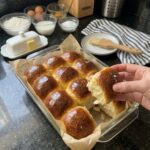
Ingredients
For the dough
- 4 cups all-purpose flour (approximately 500 g)
- 2¼ teaspoons active dry yeast (1 packet)
- ¼ cup granulated sugar (50 g)
- 1 teaspoon salt
- ¾ cup warm milk (180 ml)
- 3 large eggs, room temperature
- ½ cup unsalted butter (113 g), softened
For the egg wash
- 1 egg
- 1 tablespoon milk
Optional finishing
- Melted butter, for brushing after baking
🧂 Ingredient Notes and Smart Substitutions
All-purpose flour
All-purpose flour makes soft, tender rolls. Bread flour gives a slightly chewier, taller roll, which some people prefer for sandwich buns. Measure by weight (500 g) if possible, because brioche dough is sticky and too much flour makes the rolls dense.
Active dry yeast
This recipe uses active dry yeast, which is first dissolved in warm milk with sugar until foamy. This proves the yeast is alive. If you only have instant yeast, use the same amount and mix it with the flour, though proofing it first is still a good check.
Warm milk
The milk should be warm, not hot, about 105 to 110°F (40 to 43°C). If it is too hot, it will kill the yeast. If it is too cool, the yeast will be slow. It should feel comfortably warm on your wrist, like a warm bath. Whole milk gives the richest results.
Granulated sugar
A quarter cup gives the rolls a gentle sweetness and helps them brown. Do not skip it, even for savory uses. The sweetness is subtle and part of brioche’s flavor.
Salt
Salt flavors the dough and controls the yeast. Without it, the rolls taste flat.
Eggs at room temperature
Room-temperature eggs blend into the dough more smoothly and do not cool the milk and yeast mixture. If you forget to take them out, place the whole eggs in a bowl of warm water for 5 to 10 minutes.
Unsalted butter, softened
Softened butter should feel like cool, pliable clay, not melted or greasy. It blends smoothly into the dough. Unsalted butter lets you control the salt level. Cut the butter into small pieces and let it sit at room temperature for about 30 to 45 minutes before using.
The egg wash
One egg and a tablespoon of milk whisked together give the rolls a deep golden, shiny crust. For an extra-glossy finish, use an egg yolk with a splash of milk or cream.
Instructions
In a mixing bowl, combine the warm milk, yeast, and sugar. Let sit for 5 to 10 minutes until foamy. If the mixture does not foam, the yeast may be old, so start again with fresh yeast.
Add the eggs, flour, and salt. Mix until a soft dough forms. The dough will look rough and shaggy at first, and it will be sticky.
Knead for 5 to 8 minutes until smooth and elastic. Use a lightly floured surface, or knead in a stand mixer with the dough hook on medium-low speed.
Handling tip: Enriched dough is naturally sticky. Avoid adding too much flour, and use a bench scraper to help lift and fold the dough. The dough will become smoother and less sticky as you knead and the gluten develops.
Gradually add the softened butter, kneading until fully incorporated and the dough becomes soft and glossy. Add a few small pieces at a time, and wait until each addition is mixed in before adding more.
Tip: At first, the dough will seem to fall apart and feel greasy, as the butter and dough resist combining. Keep kneading. After several minutes, it will come together into a smooth, silky, glossy dough. In a stand mixer, this takes about 5 to 8 minutes.
How to tell it is ready: The dough should feel soft, smooth, and slightly tacky, and it should stretch thin without tearing, as in the windowpane test.
Cover and let rise in a warm place for 1 to 2 hours, or until doubled in size. Place the dough in a lightly greased bowl and cover it with plastic wrap or a clean towel.
Warm spot ideas: An oven that is turned off with the light on, a spot near a sunny window, or the top of the refrigerator. Because the dough is enriched with butter and eggs, it rises more slowly than lean dough, so be patient and watch the dough rather than the clock.
Divide the dough into 12 equal portions and shape into smooth balls. For accuracy, weigh the dough and divide by 12, so each portion is about the same size.
Shaping tip: Flatten each portion slightly, pull the edges toward the center, pinch to seal, then flip it over and roll it under your cupped palm on the counter until it forms a smooth, tight ball. A smooth surface helps the rolls rise evenly.
Arrange the rolls in a greased baking pan, leaving a little space between them. They will puff up and touch as they rise, which gives you soft, pull-apart sides.
Cover and let rise again for 45 to 60 minutes until puffy. The rolls should look noticeably larger and feel soft and airy, and a gentle fingertip press should leave a dent that fills in slowly.
Preheat the oven to 350°F (175°C) during the last 15 to 20 minutes of the second rise.
In a small bowl, whisk the egg and milk. Brush the rolls gently with the egg wash, taking care not to deflate them. Cover the tops evenly, but avoid letting the wash pool in the gaps, which can glue the rolls to the pan.
Bake for 20 to 25 minutes, until beautifully golden brown. If the tops brown too quickly, loosely cover them with foil for the last part of baking.
Doneness tip: The rolls should be a deep golden brown and sound hollow when tapped on the bottom. If you have an instant-read thermometer, the center of a roll should reach about 190°F (88°C).
Brush with melted butter if desired and allow to cool slightly before serving. Brushing the hot rolls with butter gives a soft, shiny, flavorful top. Let them cool for 10 to 15 minutes, then serve warm. 🥐