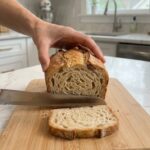
Ingredients
- 1 can (15 oz / 425 g) cannellini beans, drained and rinsed (about 240 g after draining)
- 2 large eggs
- 1 teaspoon baking powder
Optional: a pinch of salt, garlic powder or dried herbs for extra flavor.
Equipment You Will Need
- A blender or food processor
- A small loaf pan
- Parchment paper or cooking spray
- A spatula
- A clean kitchen towel or paper towels
- A wire rack
- A toothpick or skewer for testing
Instructions
Step 1: Prepare the beans 🫘
Drain and rinse the cannellini beans thoroughly. Pat them dry with a clean kitchen towel to remove excess moisture, which gives the bread a better texture.
Step 2: Blend until smooth 🥣
Add the beans, eggs and baking powder to a blender or food processor. Blend until the mixture is smooth and creamy, scraping down the sides as needed.
Step 3: Prepare the pan 🍞
Preheat your oven to 350°F (175°C). Line a small loaf pan with parchment paper or lightly grease it.
Step 4: Pour the batter ✨
Transfer the bean mixture into the prepared pan and smooth the top with a spatula.
Step 5: Bake until set 🔥
Bake for approximately 35 to 45 minutes, until the loaf is firm, lightly golden and cooked through. A toothpick inserted in the center should come out without wet batter.
Step 6: Cool before slicing 🤎
Let the loaf cool in the pan for 10 minutes, then transfer it to a wire rack. Allow it to cool completely before slicing so it holds together.
Step 7: Toast and serve 😋
For the best texture, toast the slices in a skillet or toaster until lightly crisp. Enjoy with avocado, cottage cheese, eggs or your favorite sandwich fillings.
Recipe Card at a Glance
- Prep time: 10 minutes
- Bake time: 35 to 45 minutes
- Cooling time: 30 minutes
- Total time: Approximately 1 hour 15 minutes
- Yield: 1 small loaf, about 6 to 8 slices
- Course: Breakfast, snack, side
- Method: Oven-baked
How This Recipe Works
Understanding the role of each ingredient helps you troubleshoot and customize the loaf.
Beans (structure and body). Cooked beans contain starch and protein. Once blended, they form a thick, smooth base that takes the place of flour. The starch gives the batter body, and the protein contributes to the structure as it bakes.
Eggs (binding and setting). Eggs are the glue that holds the loaf together. As they bake, the egg proteins coagulate and set, giving the loaf its firm but tender crumb. They also add moisture and richness.
Baking powder (lift). Baking powder releases gas in the heat of the oven, creating small bubbles and a slightly lighter texture. Without it, the loaf would be denser and more like a bean custard.
Together, these three simple ingredients produce a soft, moist, sliceable loaf. It will be denser and more moist than traditional bread, which is exactly what makes it satisfying.
Tips for Better Bean Bread
1. Drain the beans very well
Excess liquid can make the loaf dense, gummy or soggy. After draining, rinse the beans, shake off excess water and pat them dry with a towel.
2. Rinse the beans
Rinsing removes the starchy canning liquid, which can taste metallic or slightly salty. It also reduces sodium and gives a cleaner, milder flavor.
3. Blend thoroughly
A smooth batter creates a more even texture. Stop and scrape the sides of the blender or food processor a few times, and blend until you see no beans pieces left. A high-powered blender gives the silkiest results, but a food processor works well if you run it long enough.
4. Use fresh baking powder
Baking powder loses its power over time. If yours has been open for more than six months, test it by stirring a little into hot water. If it fizzes vigorously, it is still good.
5. Do not overfill the pan
The batter rises slightly while baking. Use a small loaf pan and leave a little room at the top. A pan that is too large will produce a thin, flat loaf that bakes faster.
6. Let it cool completely
Bean-based bread is delicate while warm and firms up as it cools. Slicing too early can cause it to crumble or feel gummy in the center. Be patient and let it cool fully on a wire rack.
7. Toast the slices
Toasting improves the texture dramatically, drying the surface slightly and adding crispness. Toast slices in a toaster, a dry skillet or a lightly oiled pan until golden.
8. Slice carefully
Use a serrated knife and a gentle sawing motion. Slice the loaf into even pieces, about ½ inch (1.25 cm) thick, for the sturdiest slices.
9. Check the doneness in the middle
The center of a bean loaf can stay moist longer than the edges. Insert a toothpick into the center; it should come out clean or with a few dry crumbs, not wet batter. If the top is browning too fast, loosely cover the loaf with foil and keep baking.
10. Adjust the baking time to your pan
Dark metal pans bake faster than glass or ceramic. Start checking at 30 to 35 minutes if you are using a dark pan.