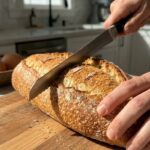
Ingredients
- 3 cups (375 g) bread flour or all-purpose flour
- 1¼ cups (300 ml) lukewarm water
- 2¼ tsp (7 g) instant yeast
- 1½ tsp salt
- 1 tsp sugar
A Closer Look at the Ingredients
Bread flour or all-purpose flour. Bread flour contains more protein, which forms more gluten and gives the loaf a chewier crumb and sturdier crust, closer to what you’d find in a French bakery. All-purpose flour makes a slightly softer, more tender loaf, and still turns out delicious. Weigh the flour at 375 grams if you can. A scooped cup can vary a lot in weight, and too much flour makes a dry, dense loaf.
Lukewarm water. Lukewarm means comfortably warm to the touch, roughly 100°F to 110°F (38°C to 43°C). Water that’s too hot will kill the yeast, while water that’s too cold slows the rise. This dough has moderate hydration, so it’s easy to knead but still produces an airy interior.
Instant yeast. Instant yeast can be mixed directly into the flour. If you only have active dry yeast, use the same amount and dissolve it in the lukewarm water with the sugar for 5 to 10 minutes, until foamy, before adding to the flour. Rise times may run slightly longer.
Salt. Salt is essential for flavor and structure, and it keeps the yeast in check. Bread without salt tastes flat and can rise unevenly. Mix the salt into the flour rather than placing it directly on the yeast.
Sugar. A teaspoon gives the yeast a quick boost and helps the crust brown beautifully. It doesn’t make the bread sweet, and traditional French bread often omits it.
Instructions
In a large bowl, combine the flour, yeast, sugar, and salt. Whisk briefly so everything is evenly distributed. Add the lukewarm water and stir with a wooden spoon or your hands until a rough, shaggy dough forms and no dry flour remains. It will look messy at this stage, and that’s normal.
Turn the dough onto a lightly floured surface and knead for 8 to 10 minutes, until it’s smooth and elastic. To knead, push the dough away from you with the heel of your hand, fold it back toward you, rotate it a quarter turn, and repeat. At first, the dough will be sticky. Resist adding too much extra flour. Dust your hands and the surface lightly, and use a bench scraper if needed. The dough is ready when it feels smooth, springs back when you poke it, and passes the windowpane test: a small piece should stretch thin enough to see light through without tearing. A stand mixer with a dough hook on low speed will take about 6 to 8 minutes.
Place the dough in a lightly greased bowl and turn it once to coat. Cover with plastic wrap or a damp towel and let it rise in a warm place for 60 to 75 minutes, or until doubled in size. A turned-off oven with the light on makes a good draft-free spot. The dough is ready when a fingertip pressed lightly into it leaves an indentation that springs back slowly.
Turn the dough out onto a lightly floured surface and divide it into two equal portions. A kitchen scale helps make them exactly equal. Gently press each portion into a rectangle, taking care not to deflate it completely. Fold the top third down to the center and press to seal, then fold the bottom third up over it and seal again. Fold the dough in half lengthwise and pinch the seam firmly closed. Then roll each piece gently under your palms, stretching it into a long loaf with tapered ends. Keep the seam on the bottom. Shaping with a bit of tension helps the loaf rise up rather than spread out.
Place the loaves on a parchment-lined baking sheet with space between them, seam side down. Cover loosely with a towel or greased plastic wrap and let them rest for 25 to 35 minutes, until puffy but not fully doubled. Meanwhile, position one oven rack in the middle and another on the lowest rung, ready for the steam pan.
Preheat the oven to 450°F (230°C). Just before baking, make 3 to 4 shallow diagonal slashes across each loaf using a very sharp knife or a bread lame. Hold the blade at about a 30-degree angle and cut roughly ¼ inch deep, with each slash slightly overlapping the next. Quick, confident cuts work better than slow, careful ones. Scoring controls where the loaf expands, producing the classic French loaf look.
Bake for 25 to 30 minutes, until the crust is deeply golden and crisp. For a crustier finish, carefully create steam by placing an oven-safe metal tray or pan on the lower rack while the oven preheats, then pouring about 1 cup of hot water into it as you load the bread. Close the oven door quickly to trap the steam. Take care to avoid steam burns. The loaves are done when they’re deep golden brown and sound hollow when tapped on the bottom. The internal temperature should be about 200°F to 210°F (93°C to 99°C).
Transfer the loaves to a wire rack and let them cool for at least 20 minutes before slicing. You may hear them crackle as they cool, which is a sign of a great crust. Cutting too early releases steam and can leave the crumb gummy.