Ingredients
This recipe makes 2 small loaves:
- 3 cups (375 g) all-purpose or bread flour
- 2¼ teaspoons instant yeast
- 1 teaspoon salt
- 1 teaspoon sugar
- 1¼ cups (300 ml) warm water
- 1 tablespoon olive oil
- Extra flour, for shaping
Ingredient Notes and Smart Swaps
Flour. Bread flour has more protein, which builds more gluten and gives a chewier, taller loaf with a sturdy crust. All-purpose flour works well too and yields a slightly softer crumb. For the best accuracy, weigh the flour. If you use measuring cups, spoon the flour into the cup and level it off rather than scooping, which can pack in extra flour and dry out the dough.
Instant yeast. Instant yeast (also called rapid-rise or bread machine yeast) can be mixed straight into the flour. If you only have active dry yeast, use the same amount but dissolve it in the warm water for 5 to 10 minutes until foamy, and expect the rises to take a little longer.
Salt. Salt adds flavor, strengthens gluten, and moderates yeast activity. Without it, the bread tastes flat. Fine sea salt or table salt works best for even distribution.
Sugar. Just one teaspoon feeds the yeast and encourages browning. It won’t make the bread sweet.
Warm water. Aim for roughly 105°F to 115°F (40°C to 46°C), which feels comfortably warm, not hot. Water that is too hot can kill yeast, while cold water slows the rise.
Olive oil. A tablespoon adds flavor and a little tenderness to the crumb without softening the crust significantly.
Extra flour. Use it sparingly for dusting your hands, the work surface, and the loaves. Too much flour changes the dough’s hydration and makes the bread denser.
Instructions
- A large mixing bowl
- A wooden spoon or dough whisk
- A clean work surface for kneading
- A stand mixer with a dough hook (optional)
- A baking sheet lined with parchment paper
- A metal baking tray or cast-iron pan for steam (not glass, which can shatter)
- A sharp knife or razor blade for scoring
- A wire cooling rack
- Oven mitts
- A kitchen scale (optional)
- An instant-read thermometer (optional)
How to Make Homemade Crispy Bread (Step by Step)
Step 1: Mix the Dough
In a large bowl, combine the flour, instant yeast, salt, and sugar. Whisk briefly to distribute everything evenly. Add the warm water and olive oil, then stir until a sticky dough forms and no dry flour remains.
Step 2: Knead Until Smooth
Turn the dough onto a lightly floured surface and knead for 8 to 10 minutes by hand, or 5 to 6 minutes with a stand mixer on medium-low speed. To knead by hand, push the dough away from you with the heel of your hand, fold it back, rotate it a quarter turn, and repeat. The dough will transform from sticky and shaggy to smooth and elastic.
Add only a little flour if it’s unmanageable. A slightly sticky dough produces the lightest, airiest interior.
The windowpane test: Pinch off a small piece and gently stretch it. If it forms a thin, translucent membrane without tearing, the gluten is well developed.
Step 3: Let the Dough Rise
Place the dough in a lightly oiled bowl, cover it, and leave it in a warm place for 60 to 75 minutes, or until doubled in size. Good spots include an oven with only the light on or a draft-free corner of the kitchen.
The poke test: Gently press a floured fingertip into the dough. If the dent springs back slowly and incompletely, it’s ready.
Step 4: Shape the Loaves
Gently deflate the dough and divide it into two equal portions. Shape each into a rustic oval loaf by patting it into a rectangle, folding it in thirds, and pinching the seam closed. Roll it gently so the surface is taut. Place each loaf seam-side down on a parchment-lined baking sheet, leaving room between them.
Step 5: Rest and Preheat
Cover the loaves loosely and let them rest for 20 to 30 minutes. Meanwhile, preheat the oven to 450°F (230°C) and place an empty metal baking tray on the lower rack. The tray must heat with the oven so it produces plenty of steam when you add water.
Step 6: Score the Bread
Dust the loaves lightly with flour. Using a sharp knife or razor blade, make one or two shallow slashes across the top of each loaf, about ¼ inch deep. Use a quick, confident motion. Scoring guides expansion and creates the classic rustic look.
Step 7: Create Steam and Bake
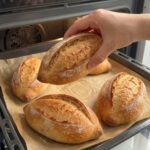
Carefully pour about 1 cup of hot water into the preheated metal tray, avoiding splashes. Place the baking sheet in the oven right away and close the door. Bake for 25 to 30 minutes, until the loaves are deeply golden and crisp. They should sound hollow when tapped on the bottom.
Keep your face and hands away from the steam, and use oven mitts. Never use a glass dish for the steam tray, since cold water on hot glass can shatter it.
Step 8: Cool Before Serving
Transfer the loaves to a wire rack and let them cool for at least 20 minutes before slicing. As they cool, you may hear the crust crackle. That’s the sign of a properly crisp loaf. Cooling also lets the interior finish setting, which prevents a gummy crumb.