Ingredients
For the pita dough
- 3 cups (375 g) all-purpose flour or bread flour
- 1 cup (240 ml) warm water
- 2 teaspoons instant yeast
- 1 tablespoon olive oil
- 1 teaspoon sugar
- 1 teaspoon salt
For shaping
- A little extra flour for dusting
- Olive oil for serving (optional)
What Makes Pita Puff?
The pocket in pita bread is not a coincidence. It is physics and baking science working together:
- A very hot baking surface. When the thin dough round hits a surface heated to around 475°F (245°C), the bottom of the dough sets quickly.
- Rapid steam formation. The moisture in the dough instantly turns to steam inside the round.
- Expansion. The steam expands and pushes the top and bottom layers of the dough apart.
- Setting the structure. The outer layers firm up quickly, trapping the pocket in place as the bread finishes baking.
For this to work, the dough must be rolled evenly, so the steam inflates the round uniformly instead of escaping through a thin spot. The baking surface must be truly hot, so the heat shock is fast and strong. And the dough must not be dried out or overbaked, so the surface stays flexible enough to stretch.
Instructions
In a large mixing bowl, combine the warm water, sugar and instant yeast. Stir gently and let stand for 5 minutes. If you are using instant yeast, you can proceed even if the mixture does not become very foamy. The water should be warm, not hot, since water that is too hot can kill the yeast.
Add the flour, salt and olive oil. Mix until a rough dough forms. Transfer the dough to a lightly floured surface and knead for 8 to 10 minutes, until smooth, soft and elastic. The dough should feel slightly tacky but should not stick excessively to your hands.
Place the dough in a lightly greased bowl and cover it with a clean kitchen towel or plastic wrap. Let it rise in a warm place for 45 to 60 minutes, or until approximately doubled in size.
Gently press the dough to release excess air. Divide it into 8 equal pieces and roll each into a smooth ball. Cover the dough balls with a towel and let them rest for 10 to 15 minutes. This makes them easier to roll without shrinking back.
Lightly flour your work surface and roll each dough ball into a round approximately 6 to 7 inches (15 to 18 cm) wide and about ⅛ inch (3 to 4 mm) thick. Try to keep the thickness even across the entire round. Avoid making the edges much thinner than the center, as this can prevent the pita from puffing evenly. Cover the rolled rounds with a clean towel while you prepare the oven.
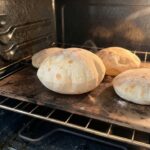
Place a heavy baking tray, baking steel or pizza stone on the middle rack. Preheat the oven to 475°F (245°C) for at least 20 to 30 minutes so the baking surface becomes thoroughly hot. A very hot baking surface is the secret to creating the steam inside the dough that makes the pita puff into a pocket.
Carefully place one or two pita rounds on the hot baking surface, leaving enough room between them. Bake for approximately 2 to 3 minutes. Watch as the dough begins to inflate, forming a beautiful, airy pocket. Once fully puffed and lightly colored, remove the pita carefully with tongs. Avoid overbaking, as this can make the bread dry and crisp rather than soft. Repeat with the remaining rounds.
Immediately place the baked pita breads inside a clean kitchen towel and cover them. Stacking and covering the warm pitas traps a little moisture, helping keep their crusts soft and flexible.
Serve the pita breads warm while they are soft and fluffy. Carefully open the pocket with a knife and fill it with grilled chicken, falafel, hummus, cucumber, tomatoes, lettuce or your favorite fillings. You can also cut the pitas into wedges and serve with hummus, tzatziki or baba ganoush. 🫓✨