Ingredients
For the dough:
- 3½ cups (440 g) bread flour
- 2¼ teaspoons (7 g) instant yeast
- 1 tablespoon sugar
- 1 teaspoon salt
- 1¼ cups (300 ml) warm water
- 2 tablespoons melted butter
For the boiling water:
- 8 cups (2 liters) water
- ½ cup baking soda
For the topping:
- 1 egg, beaten
- Coarse salt, to taste
- 1 tablespoon melted butter, optional
Ingredient Notes and Smart Swaps
Bread flour. Bread flour’s higher protein content builds a stronger gluten network, which is key to the chewy texture. All-purpose flour works in a pinch, but the rolls will be slightly softer and less chewy. Weigh your flour if possible, since a cup can vary by 20 to 30 grams depending on how it’s scooped.
Instant yeast. Instant yeast can be mixed directly into the dry ingredients. If you have active dry yeast, use the same amount and dissolve it in the warm water for 5 to 10 minutes until foamy. Rising may take a little longer.
Sugar. A small amount feeds the yeast and encourages browning. Brown sugar or honey can replace it.
Salt. It builds flavor and regulates yeast activity. Don’t skip it.
Warm water. Aim for 105°F to 115°F (40°C to 46°C). Too hot kills yeast; too cold slows the rise.
Melted butter. Butter adds richness and tenderness to the crumb. Let it cool slightly so it doesn’t harm the yeast.
Baking soda. This is what creates the pretzel crust. Use regular baking soda, not baking powder. The amount is generous, but it’s meant for the boiling water, not the dough.
Egg wash. The beaten egg gives the rolls a deep, glossy shine. For an egg-free version, brush with a little milk or melted butter, though the color will be less dramatic.
Coarse salt. Pretzel salt, flaky sea salt, or kosher salt all work. Coarse crystals hold their shape and crunch better than fine salt.
Instructions
- A large mixing bowl
- A clean work surface for kneading
- A large, wide pot for boiling (stainless steel or enamel is best)
- A slotted spoon or spider strainer
- A parchment-lined baking tray
- A pastry brush for the egg wash
- A sharp knife or razor blade for scoring
- A wire cooling rack
- A kitchen scale (optional) for accurate measuring
A quick note on cookware: baking soda can discolor aluminum pots, so a stainless steel or enamel-coated pot is the better choice.
How to Make Homemade Pretzel Rolls (Step by Step)
Step 1: Prepare the Dough
In a large bowl, combine the flour, instant yeast, sugar, and salt. Add the warm water and melted butter. Mix until a shaggy dough forms and no dry flour remains.
Step 2: Knead and Rise
Turn the dough onto a lightly floured surface and knead for 8 to 10 minutes, until smooth and elastic. Push the dough away with the heel of your hand, fold it over, rotate a quarter turn, and repeat. A stand mixer with a dough hook on medium-low speed will take about 6 to 8 minutes.
To check gluten development, try the windowpane test: stretch a small piece of dough between your fingers. If it forms a thin, translucent sheet without tearing, it’s ready.
Place the dough in a lightly greased bowl, cover, and let it rise in a warm place for 60 to 75 minutes, or until doubled in size.
Step 3: Shape the Rolls
Divide the dough into 8 equal pieces. A kitchen scale makes this easy, with each piece weighing roughly 100 to 105 grams. Shape each into a smooth ball by tucking the edges underneath and rolling the dough against the counter in a cupped hand until the surface is taut.
Place the balls on a lightly floured surface, cover, and rest for 15 minutes. This relaxes the gluten and puffs the rolls slightly.
Step 4: Prepare the Boiling Water
Preheat the oven to 425°F (220°C). Line a baking tray with parchment paper.
Bring 8 cups (2 liters) of water to a gentle boil in a large pot. Carefully add the baking soda a little at a time, because the water will foam up. Wait for the foaming to settle before adding more. Reduce the heat so the water stays at a gentle simmer.
Step 5: Boil the Dough
Using a slotted spoon, carefully lower each roll into the simmering water. Boil for 20 to 30 seconds per side, then lift out, drain well, and place on the parchment-lined tray. Work in batches of two or three rolls so the pot isn’t crowded, and so each roll has room to float freely.
Don’t boil longer than 30 seconds per side, or the crust may turn tough and the rolls can develop a slightly metallic flavor.
Step 6: Add the Topping
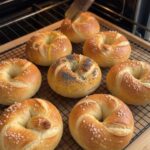
Brush each roll with beaten egg and sprinkle with coarse salt. If you like, use a sharp knife to make a small slash or an X on top. This helps the roll expand evenly and gives it a classic bakery look.
Step 7: Bake Until Golden
Bake for 15 to 20 minutes, until the rolls are deep golden brown and cooked through. They should sound hollow when tapped on the bottom. An instant-read thermometer should read about 190°F to 200°F (88°C to 93°C) in the center.