Ingredients
- 3 cups (375 g) all-purpose flour or bread flour
- 1 cup (240 ml) warm milk
- 2 tablespoons (25 g) granulated sugar
- 2 teaspoons (7 g) instant yeast
- 1 teaspoon salt
- 2 tablespoons (28 g) unsalted butter, melted
- 1 large egg, room temperature
For the Egg Wash
- 1 egg
- 1 tablespoon milk
Optional Topping
- 1 tablespoon melted butter for brushing after baking
Ingredient Notes
Flour. All-purpose flour gives a soft, tender loaf, while bread flour has more protein and produces a slightly chewier, taller loaf with more structure. Both work well here. If you can, weigh your flour. Scooping flour straight from the bag packs it down and can add too much, which leads to a dense loaf. If you use cups, spoon the flour into the cup and level it with a knife.
Warm milk. The milk should feel comfortably warm to the touch, roughly 100–110°F (38–43°C). It should never be hot. Milk that is too hot can damage or kill the yeast, and bread will not rise. Whole milk gives the richest flavor and softest texture, but 2% milk works too.
Sugar. A small amount of sugar feeds the yeast, helps the crust brown and adds a very gentle sweetness. This is not a sweet bread, just one with a hint of richness.
Instant yeast. Instant yeast can be mixed directly with the other ingredients. If you only have active dry yeast, you can use the same amount, but let it sit in the warm milk and sugar for about 5 minutes until foamy before continuing. The foam tells you the yeast is alive and active.
Salt. Salt controls the yeast, strengthens the dough and brings out flavor. Do not skip it, or the bread will taste flat.
Melted butter. Butter adds flavor, softness and a tender crumb. Let it cool slightly before adding so it does not warm the dough too much.
Egg. The egg enriches the dough, adds structure and gives a lovely golden color to the crumb. Use it at room temperature so it blends in smoothly and does not chill the dough.
Egg wash. The mixture of egg and milk brushed on top gives the loaf a glossy, deep golden crust that looks like it came from a bakery.
Instructions
In a large mixing bowl, combine the warm milk, sugar and yeast. If you are using active dry yeast, let the mixture sit for about 5 minutes until foamy. With instant yeast you can move on right away.
Add the egg, melted butter, flour and salt to the bowl. Mix with a wooden spoon or sturdy spatula until a sticky, soft dough forms and no dry flour remains. The dough will look shaggy and wet. This is exactly right. No kneading is necessary!
Cover the bowl with a clean kitchen towel or plastic wrap. Let the dough rise in a warm place for 1 to 1½ hours, or until it has doubled in size and looks puffy with visible bubbles. A turned-off oven with the light on, or a spot near a warm (not hot) appliance, is an ideal rising spot.
Lightly grease a standard loaf pan (about 9 × 5 inches). Gently transfer the risen dough to a lightly floured surface. With floured hands, shape it into a loaf by folding the edges toward the center, then pinching the seam closed. Place it seam-side down into the prepared pan. Handle the dough gently to keep the air bubbles that make the bread fluffy.
Cover the pan and let the dough rise for another 30 to 45 minutes, until puffy and nearly doubled, rising to just above the edge of the pan. Do not let it overproof, or it may collapse in the oven.
Whisk the egg and milk together until smooth. Gently brush it over the top of the dough using a soft pastry brush. Be careful not to let the egg wash drip down the sides of the pan, as it can glue the bread to the pan and limit the rise.
Preheat your oven to 350°F (175°C) while the dough finishes its second rise. Bake for 30 to 35 minutes, until the loaf is deep golden brown and fully baked. The bread should sound hollow when tapped on the bottom, and an instant-read thermometer inserted into the center should read about 190–200°F (88–93°C). If the top browns too quickly, loosely cover it with a piece of aluminum foil for the remaining time.
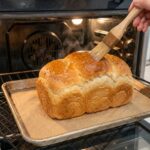
Remove the bread from the oven and brush the top with melted butter if desired. This keeps the crust soft and adds a beautiful sheen. Let the loaf cool in the pan for 10 minutes, then carefully turn it out onto a wire rack to cool.
Let the bread cool for at least 30 minutes before slicing. Cutting too soon can make the crumb gummy because the inside is still setting. Use a serrated bread knife for clean slices. Enjoy with butter, jam, honey or your favorite sandwich fillings! 🍞❤️