
Homemade Soft & Fluffy Bread Rolls
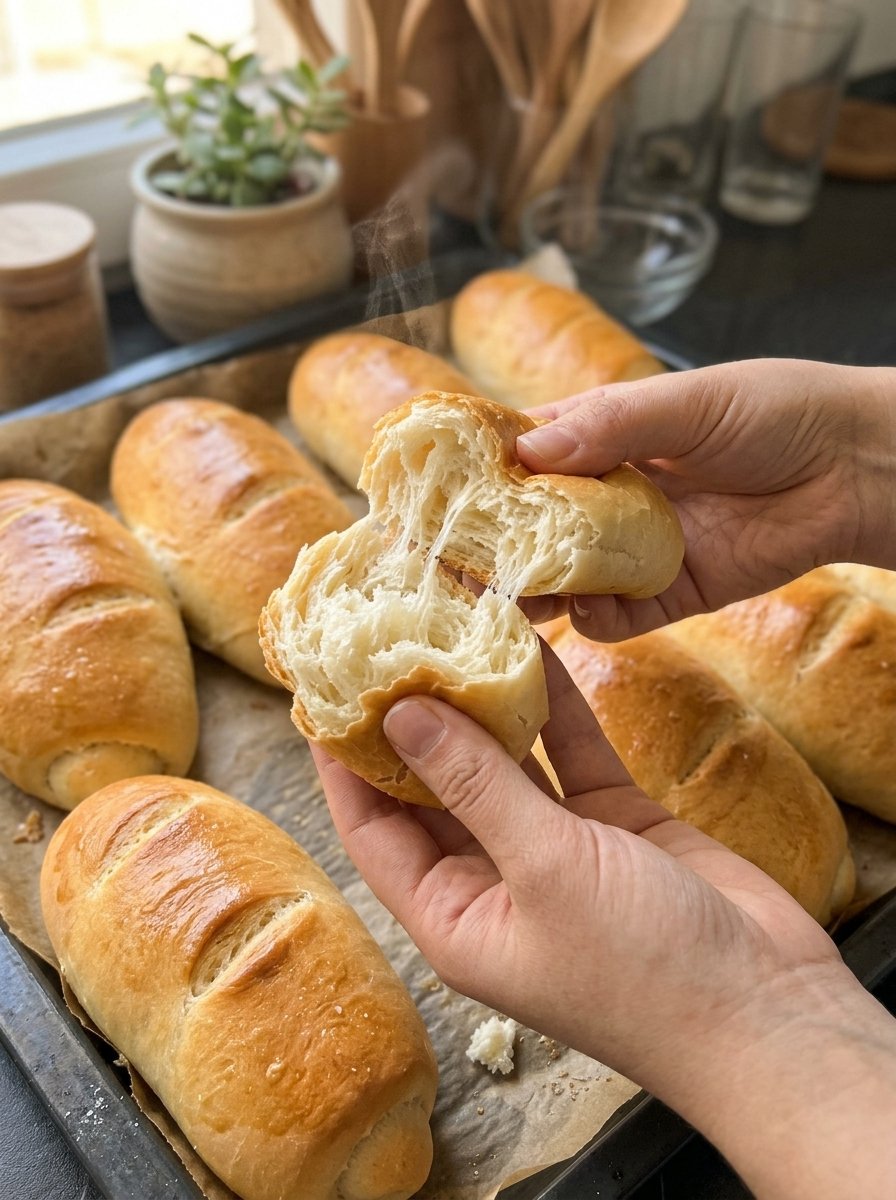
Homemade Soft & Fluffy Bread Rolls: Golden, Buttery & Pillowy 🍞😍
Homemade Soft & Fluffy Bread Rolls Recipe (Golden, Buttery & Easy) Meta description: Bake homemade soft and fluffy bread rolls with a golden crust and a tender, pillowy center. Simple pantry ingredients, perfect for sandwiches, burgers, breakfast, and serving with soup. Focus keyword: soft bread rolls Secondary keywords: fluffy bread rolls, homemade dinner rolls, soft homemade rolls, easy bread roll recipe, milk and butter rolls, rolls for sandwiches and burgers, golden dinner rolls, homemade rolls from scratch
Homemade, golden, and absolutely delicious! 😍 These Soft & Fluffy Bread Rolls have a beautifully golden crust and a tender, pillowy center that makes every bite irresistible. They are made with simple pantry ingredients, and they are light, slightly buttery, and perfect for sandwiches, burgers, breakfast, or serving warm alongside your favorite soups and family meals.
Once you try them fresh from the oven, you will never want store-bought rolls again! ❤️
These rolls are a true everyday bake. The dough comes together in one bowl, it rises in a warm corner of the kitchen while you do something else, and the result is a tray of twelve soft, golden rolls that work for nearly any meal. They are less rich than brioche, but just as soft, thanks to a simple mix of warm milk, a little butter, and one egg.
In this complete guide, you will find the full recipe, step-by-step instructions, ingredient notes, shaping help, tips for the softest texture, troubleshooting, serving ideas, variations, storage and freezing tips, and answers to common questions. Let’s bake! 👩🍳
📝 A Note About This Recipe
The recipe card for these rolls lists the rise and bake times in the steps, but it does not give an overall prep or total time. The prep and total times in the overview below are my estimates. The ingredients, rise times, oven temperature, and bake time are from your recipe. It makes 12 rolls.
📋 Recipe Overview
🤔 What Makes a Bread Roll Soft and Fluffy?
Not every bread roll is soft. Some are crusty and chewy, like the rolls you might find at an artisan bakery. These rolls are the other kind: tender, light, and pillowy, with a thin, golden crust. A few simple choices in the recipe make that difference.
- Milk instead of water. The milk proteins and fat make the crumb softer and the crust more golden and tender.
- Butter. A little softened butter coats the gluten strands and makes the crumb tender instead of tough.
- An egg. One egg adds richness, color, and softness, and it helps the rolls rise and hold their shape.
- Sugar. A quarter cup feeds the yeast, adds a subtle sweetness, and helps the rolls brown.
- A properly kneaded dough. Smooth, elastic dough traps air and bakes up light.
- Full rising time. Two good rises create the airy, pillowy texture.
- Butter after baking. Brushing the warm rolls with melted butter keeps the crust soft and adds flavor.
❤️ Why You Will Love This Recipe
- ✅ Soft, light, and pillowy. A tender center with a thin golden crust.
- ✅ Simple pantry ingredients. Flour, yeast, sugar, salt, milk, butter, and egg.
- ✅ Slightly buttery. Rich enough to taste wonderful, light enough for everyday meals.
- ✅ Versatile. Dinner rolls, burger buns, sandwich rolls, and breakfast bread.
- ✅ Beginner friendly. No special equipment or tricky techniques.
- ✅ Makes 12 rolls. Enough for a family dinner or a batch of sandwiches.
- ✅ Golden and beautiful. The egg wash gives a bakery-style shine.
- ✅ Freezer friendly. Bake ahead and refresh as needed.
- ✅ Better than store-bought. Fresher, softer, and made with ingredients you know.
🛒 Ingredients
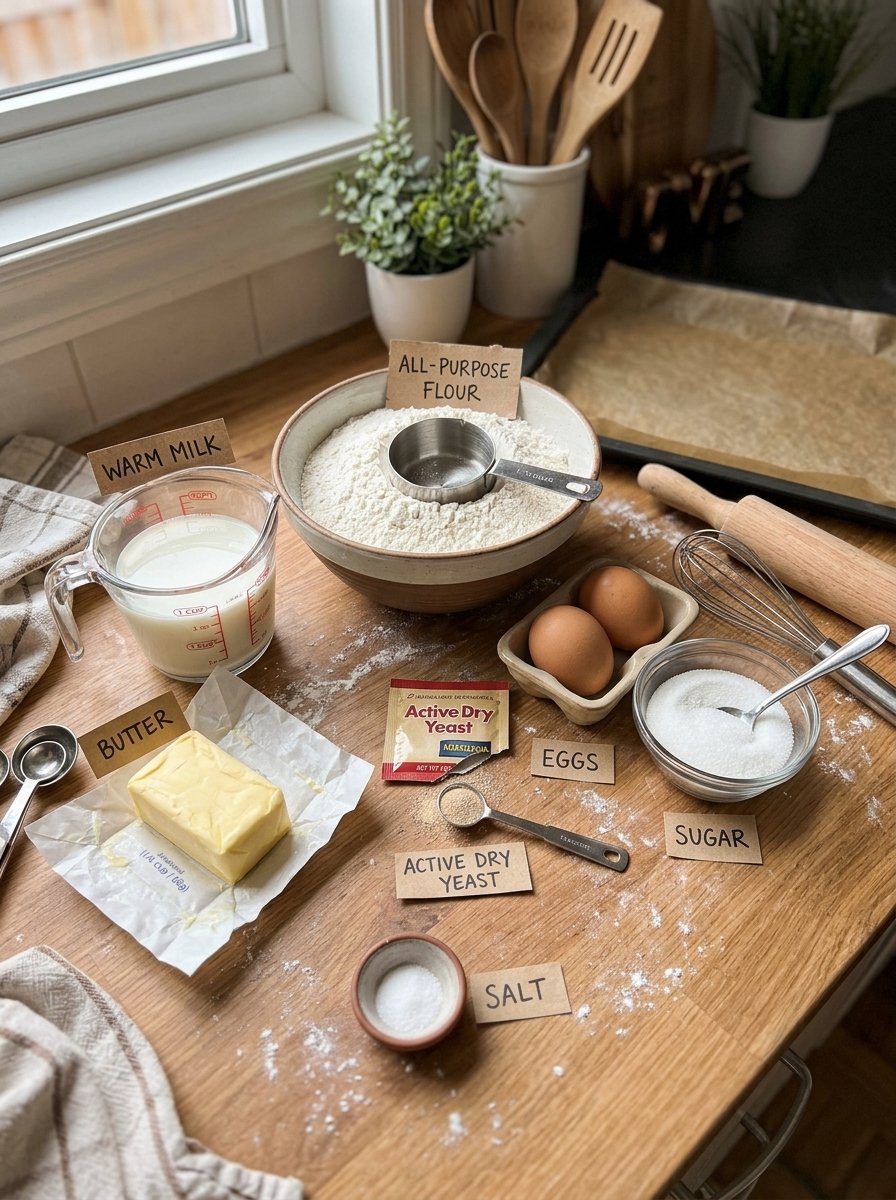
For the rolls
- 4 cups all-purpose flour (approximately 500 g)
- 2¼ teaspoons active dry yeast (1 packet)
- ¼ cup granulated sugar (50 g)
- 1 teaspoon salt
- 1 cup warm milk (240 ml)
- ¼ cup unsalted butter (56 g), softened
- 1 large egg, room temperature
For the egg wash
- 1 egg
- 1 tablespoon milk
To finish
- Melted butter, for brushing after baking
🧂 Ingredient Notes and Smart Substitutions
All-purpose flour
All-purpose flour is the star here, and it makes tender, soft rolls. Bread flour gives a slightly taller, chewier roll, which some people like for burgers and sandwiches. Measure by weight if you can (500 g), because too much flour is the most common cause of dense rolls.
Active dry yeast
One packet of active dry yeast (2¼ teaspoons) is dissolved in warm milk with sugar until foamy. This confirms the yeast is alive. If you have instant yeast, use the same amount and mix it into the flour, though proofing it first is a useful check.
Warm milk
The milk should be warm, not hot, about 105 to 110°F (40 to 43°C). Milk that is too hot will kill the yeast, and milk that is too cool will slow it. It should feel like a warm bath on your wrist. Whole milk gives the softest, richest rolls, though 2 percent works too.
Granulated sugar
A quarter cup gives the rolls a gentle sweetness and a beautiful golden crust, and it feeds the yeast. This sweetness is mild, so the rolls still work well in savory sandwiches.
Salt
Salt flavors the dough and controls the yeast. Without it, the rolls taste flat and may over-rise.
Unsalted butter, softened
Softened butter should feel cool but pliable, like soft clay. It mixes smoothly into the dough and gives a tender crumb. Unsalted butter lets you control the salt. If you only have salted butter, reduce the added salt slightly.
Egg at room temperature
A room-temperature egg blends into the dough smoothly and does not cool down the yeast mixture. If you forget to take it out, place the egg in a bowl of warm water for 5 to 10 minutes.
The egg wash
One egg whisked with a tablespoon of milk gives the rolls a deep golden color and a shiny, bakery-style crust. For an even shinier finish, use only the egg yolk with a splash of milk.
Melted butter for brushing
Brushing the hot rolls with melted butter softens the crust, adds flavor, and gives a glossy finish.
👩🍳 How to Make Soft & Fluffy Bread Rolls: Step-by-Step
Step 1: Proof the yeast
In a large bowl, combine the warm milk, yeast, and sugar. Let stand for 5 to 10 minutes until foamy. If it does not foam, the yeast may be old or the milk was too hot or cold, so start again.
Step 2: Mix the dough
Add the egg, softened butter, flour, and salt. Mix until a soft dough forms. Use a wooden spoon or a dough hook. The dough will look shaggy and a little sticky.
Tip: Add the flour gradually, holding back the last ½ cup. You may not need all of it, depending on humidity and how your flour absorbs liquid.
Step 3: Knead
Knead for 8 to 10 minutes until smooth, elastic, and slightly tacky. Turn the dough onto a lightly floured surface, push it away with the heel of your hand, fold it over, give it a quarter turn, and repeat. In a stand mixer, use the dough hook on medium-low speed for about 6 to 8 minutes.
How to tell it is ready: The dough should feel soft and springy, and it should bounce back slowly when you press it. It should still be slightly tacky, not dry. For a closer check, try the windowpane test. Stretch a small piece of dough thin. If it forms a translucent membrane without tearing, the gluten is well developed.
Step 4: First rise
Place the dough in a lightly greased bowl, cover, and let rise for 1 to 1½ hours, or until doubled in size. Cover with plastic wrap or a clean towel.
Warm spot ideas: Put the bowl in an oven that is turned off with the light on, near a sunny window, or on top of the refrigerator. If your kitchen is cool, it may take longer. Watch the dough rather than the clock.
Step 5: Punch down and divide
Gently punch down the dough and divide it into 12 equal portions. Press the dough gently to release the large air bubbles. For equal rolls, weigh the whole piece of dough and divide the weight by 12.
Step 6: Shape the rolls
Shape each portion into a smooth ball and arrange on a lined baking sheet. Flatten each portion slightly, pull the edges into the center and pinch, then flip it over and roll it under your cupped palm on the counter until smooth and round. Place the rolls on a parchment-lined baking sheet, leaving a little space between them.
Tip: A smooth, tight surface helps the rolls rise evenly and bake with a nice rounded top. Leave about 1 inch (2.5 cm) between rolls for separate rolls, or place them closer for pull-apart rolls with soft sides.
Step 7: Second rise
Cover and let rise again for 30 to 45 minutes until puffy. The rolls should look noticeably bigger, and when you press one gently with a fingertip, the dent should fill back in slowly.
Step 8: Preheat the oven
Preheat the oven to 350°F (175°C) during the last 15 to 20 minutes of the second rise.
Step 9: Brush with egg wash
Whisk the egg and milk in a small bowl. Brush the rolls gently with the egg wash. Use a soft brush and a light touch, so that you do not deflate the rolls. Avoid letting the wash pool at the base, which can make the rolls stick to the parchment.
Step 10: Bake
Bake for 18 to 22 minutes, until beautifully golden brown. If the tops brown too quickly, loosely tent them with foil.
Doneness tip: The rolls should be a deep golden brown and sound hollow when tapped on the bottom. The center should reach about 190°F (88°C) on an instant-read thermometer.
Step 11: Brush with butter
Brush with melted butter while warm for an extra-soft, delicious finish. Do this right after the rolls come out of the oven, so that the butter soaks in and the crust stays tender and glossy.
Step 12: Cool and serve
Let cool slightly and serve fresh! Let the rolls rest for 10 to 15 minutes, which helps the crumb finish setting, then enjoy them warm. 🍞
🔬 The Secrets to Soft, Fluffy Rolls
1. Do not overdo the flour
Extra flour is the number one cause of dense rolls. Keep the dough soft and slightly tacky. If it sticks to your hands, dust your hands and the counter lightly, instead of kneading in extra flour.
2. Knead long enough
Eight to ten minutes of kneading builds the gluten that traps air. A well-kneaded dough rises higher and bakes lighter.
3. Use warm, not hot, milk
Milk that is warm to the touch wakes up the yeast. Milk that is too hot kills it, which means no rise at all.
4. Give the dough time
Rising gives the yeast time to make gas and gives the dough its airy texture. A rushed rise gives dense rolls.
5. Do not over-proof
Rolls that rise too long can collapse and taste overly yeasty. Look for puffy, soft rolls that spring back slowly.
6. Use the egg wash
It gives the crust color, shine, and a thin, tender skin.
7. Butter the rolls right away
Brushing butter on hot rolls softens the crust and locks in moisture.
8. Store them properly
An airtight container keeps rolls soft, while leaving them uncovered dries them out.
💡 Tips for Perfect Bread Rolls
- Use warm, not hot, milk to activate the yeast properly.
- Avoid adding too much flour, as this can make the rolls dense.
- Allow the dough enough time to rise for the softest texture.
- Brush the rolls with butter immediately after baking for a tender crust.
- Store leftovers in an airtight container at room temperature for up to 3 days.
- Weigh the dough. Equal portions bake evenly and look professional.
- Use room-temperature egg and softened butter. They blend into the dough smoothly.
- Use a stand mixer if you have one. It makes the kneading easy.
- Do not overbake. Overbaked rolls turn dry, so remove them as soon as they are deeply golden.
- Rotate the pan. Turn the baking sheet halfway through for even browning.
🔧 Troubleshooting: Common Bread Roll Problems
My rolls are dense and heavy. Too much flour, under-rising, or old yeast can all cause density. Measure by weight, let both rises finish, and check that the yeast foams in step 1.
My dough did not rise. The yeast may be expired, or the milk may have been too hot or too cold. Make sure the milk is warm to the touch, not hot, and the rising place is not too cool. Give it extra time.
My dough is too sticky. Slightly tacky is correct. If it is clinging to your hands, flour your hands and the counter lightly, and keep kneading, since the dough becomes smoother as the gluten develops.
My dough is too dry or stiff. You may have added too much flour. Knead in a tablespoon of warm milk at a time until the dough is soft.
My rolls are dry. They may have been overbaked, or the dough may have had too much flour. Bake until golden and no longer, and brush with butter right away.
The rolls spread flat. The dough may have been over-proofed or too wet, or the shaping may have been loose. Shape tight balls, and bake as soon as the rolls look puffy.
The tops browned too fast. Cover loosely with foil for the rest of the baking time.
The bottoms are too dark. Move the baking sheet to a higher rack, or place a second baking sheet beneath for insulation. Light-colored pans brown more gently than dark ones.
The rolls are pale. Make sure you brushed them evenly with egg wash, and bake until deeply golden. Check that the oven is at the right temperature.
The rolls are gummy inside. They may be underbaked or cut too soon. Bake until the center reaches about 190°F (88°C), and let them cool slightly before serving.
The rolls have a strong yeasty smell. They may have over-proofed. Shorten the second rise slightly next time, and use the poke test.
The rolls hardened after a day. Store them in an airtight container, not uncovered. Reheat them briefly in the oven to refresh.
🍽 Serving Ideas
With meals
- Soups and stews: Perfect for dunking in tomato soup, chicken soup, or chili.
- Roast chicken, turkey, or ham: A soft roll soaks up juices and gravy.
- Pasta and casseroles: A classic side.
- Salads: A warm roll turns a salad into a satisfying meal.
- Holiday dinners: Easy to bake ahead for big family meals.
For sandwiches and burgers
- Burger buns: Slice and fill with burgers and your favorite toppings.
- Sliders: Make small rolls for mini sandwiches.
- Ham and cheese: A simple, satisfying sandwich.
- Chicken or tuna salad: The soft crumb holds creamy fillings well.
- Pulled pork or chicken: A soft bun for saucy fillings.
- Breakfast sandwiches: Fill with eggs, cheese, and bacon or sausage.
For breakfast and snacks
- Butter and honey: Warm rolls with honey and butter.
- Homemade jam: Spread with strawberry, raspberry, or apricot jam.
- Cream cheese: A simple, satisfying topping.
- Jam and peanut butter: A kid-friendly snack.
- Scrambled eggs on the side: A cozy breakfast.
Make it something new
- Garlic butter rolls: Brush with garlic butter and parsley.
- Cheese rolls: Top with shredded cheese in the last 3 minutes of baking.
- Bread pudding: Use stale rolls for a comforting dessert.
- French toast: Slice and soak in custard.
- Croutons and breadcrumbs: Make use of day-old rolls.
🌿 Delicious Flavor Variations
- Honey butter rolls: Brush with a mix of melted butter and honey after baking.
- Garlic herb rolls: Add 1 teaspoon of garlic powder and 1 teaspoon of dried herbs to the flour, and brush with garlic butter after baking.
- Cheesy rolls: Knead in ½ cup of shredded cheddar, or sprinkle cheese over the egg wash before baking.
- Sesame or poppy seed rolls: Sprinkle over the egg wash before baking, ideal for burger buns.
- Everything seasoning rolls: Sprinkle everything bagel seasoning over the egg wash.
- Cinnamon sugar rolls: Brush with melted butter after baking and dip in cinnamon sugar.
- Whole wheat rolls: Replace up to 1 cup of the flour with whole wheat flour, adding a splash more milk if needed.
- Rosemary rolls: Add 1 tablespoon of chopped fresh rosemary and sprinkle with flaky salt.
- Pull-apart rolls: Arrange the rolls close together so that they touch as they rise.
- Mini rolls: Divide into 16 to 18 smaller portions and shorten the baking time.
- Hot dog or hamburger buns: Shape into ovals or flatten into rounds, and check the baking time.
- Overnight rolls: Shape the rolls, cover, and refrigerate overnight, then let them come to room temperature and rise before baking. This has not been tested for this recipe, so watch the dough closely.
📦 Storage, Freezing, and Reheating
Room temperature
Store leftovers in an airtight container at room temperature for up to 3 days. The rolls are at their best on the first day.
Freezer
Cool the rolls completely, then freeze them in a freezer-safe bag for up to 2 to 3 months. Press out the air to prevent freezer burn.
Thawing and reheating
Thaw at room temperature for 1 to 2 hours, or warm directly from frozen in a 350°F (175°C) oven for 8 to 10 minutes, wrapped in foil to keep them soft. A quick 10 to 15 seconds in the microwave also works for a single roll, though the crust will be softer.
Freezing unbaked dough
Shape the rolls, freeze them on a tray until firm, then transfer to a bag. Thaw in the refrigerator, let them rise until puffy, and bake as directed.
Using leftovers
Turn extra rolls into croutons, breadcrumbs, French toast, bread pudding, or toasted sandwiches.
🥗 Nutrition Notes
These rolls are a simple, lightly enriched bread made with milk, butter, and one egg. They are a satisfying side for meals or a soft base for sandwiches. As with any bread, enjoy them as part of a balanced meal.
Exact nutrition varies depending on ingredients and roll size. For accurate numbers, use a nutrition calculator with your specific ingredients.
❓ Frequently Asked Questions
What is the secret to soft bread rolls?
Warm milk, a little butter, an egg, proper kneading, full rising times, and not adding too much flour. Brushing with butter right after baking also keeps the crust tender.
Can I use bread flour?
Yes. Bread flour makes slightly taller, chewier rolls. All-purpose flour gives a more tender result and works very well.
Can I use instant yeast?
Yes. Use the same amount, and mix it into the flour. The rise may be slightly faster, and proofing in milk is still a good check.
Do I need a stand mixer?
No. You can mix with a wooden spoon and knead by hand for 8 to 10 minutes. A stand mixer makes it easier but is not required.
Can I use water instead of milk?
You can, but the rolls will be less soft and rich, and the crust will be paler. Milk gives the best results.
Can I use plant-based milk?
Yes, but the texture and flavor will differ. Use an unsweetened plant-based milk, and warm it as directed.
Why did my rolls turn out dense?
The most common causes are too much flour, not enough rising time, and old yeast. Measure carefully and let the dough double.
Can I make the dough ahead of time?
You can shape the rolls, cover them tightly, and refrigerate overnight. Let them come to room temperature and finish rising before baking. This has not been tested for this recipe, so watch the dough closely.
How do I know when the rolls are done?
They should be a deep golden brown and sound hollow when tapped on the bottom. The center should reach about 190°F (88°C).
Can I skip the egg wash?
Yes, but the rolls will be paler and less glossy. Brushing with milk or melted butter is a simpler alternative.
Can I make rolls without an egg?
The egg adds richness and softness. You can try replacing it with an extra tablespoon or two of milk, but the texture may be slightly different.
Can I freeze the dough?
Yes. Shape the rolls, freeze them on a tray, then bag them. Thaw in the refrigerator, rise, and bake.
How do I keep the rolls soft?
Brush with butter right after baking, cool slightly, and store in an airtight container.
Can I make these into burger buns?
Yes. Flatten each ball slightly before the second rise, and check for doneness a minute or two earlier.
Can I use salted butter?
Yes, but reduce the added salt slightly, to about ¾ teaspoon.
Why is my dough sticky?
It should be slightly tacky. If it is very sticky, knead longer so the gluten develops, and add flour a tablespoon at a time only if needed.
How many rolls does this make?
Twelve rolls, each about the size of a standard dinner roll.
Can I make smaller rolls?
Yes. Divide the dough into 16 or 18 pieces, and shorten the baking time.
🏁 Final Thoughts
These Homemade Soft & Fluffy Bread Rolls prove that a handful of pantry ingredients can turn into something wonderful. They are golden, tender, slightly buttery, and made with simple steps, and they are perfect for sandwiches, burgers, breakfast, or serving warm with soup and family meals. 😍
Make a batch tonight, and enjoy them fresh from the oven. Once you try them, you will never want store-bought rolls again. ❤️
If you try this recipe, leave a comment and a star rating below, and tell us whether you love your rolls with butter, honey, or homemade jam. Happy baking! 💛
📌 Quick Recipe Card
Homemade Soft & Fluffy Bread Rolls ⏳ First rise: 1 to 1½ hrs | ⏳ Second rise: 30 to 45 min | 🔥 Bake: 18 to 22 min | 🍽 Yield: 12 rolls
Ingredients: 4 cups all-purpose flour (about 500 g), 2¼ tsp active dry yeast (1 packet), ¼ cup granulated sugar (50 g), 1 tsp salt, 1 cup warm milk (240 ml), ¼ cup unsalted butter (56 g, softened), 1 large egg (room temperature). Egg wash: 1 egg and 1 tbsp milk.
Method: Combine the warm milk, yeast, and sugar and let stand 5 to 10 minutes until foamy. Add the egg, softened butter, flour, and salt and mix into a soft dough. Knead 8 to 10 minutes until smooth, elastic, and slightly tacky. Place in a lightly greased bowl, cover, and let rise 1 to 1½ hours until doubled. Gently punch down, divide into 12 equal portions, and shape into smooth balls on a lined baking sheet. Cover and rise 30 to 45 minutes until puffy. Preheat the oven to 350°F (175°C). Brush with the egg wash and bake 18 to 22 minutes until golden brown. Brush with melted butter while warm, cool slightly, and serve.
Storage: Store in an airtight container at room temperature for up to 3 days, or freeze for up to 2 to 3 months.
Print
Homemade Soft & Fluffy Bread Rolls
Ingredients
For the rolls
- 4 cups all-purpose flour (approximately 500 g)
- 2¼ teaspoons active dry yeast (1 packet)
- ¼ cup granulated sugar (50 g)
- 1 teaspoon salt
- 1 cup warm milk (240 ml)
- ¼ cup unsalted butter (56 g), softened
- 1 large egg, room temperature
For the egg wash
- 1 egg
- 1 tablespoon milk
To finish
- Melted butter, for brushing after baking
🧂 Ingredient Notes and Smart Substitutions
All-purpose flour
All-purpose flour is the star here, and it makes tender, soft rolls. Bread flour gives a slightly taller, chewier roll, which some people like for burgers and sandwiches. Measure by weight if you can (500 g), because too much flour is the most common cause of dense rolls.
Active dry yeast
One packet of active dry yeast (2¼ teaspoons) is dissolved in warm milk with sugar until foamy. This confirms the yeast is alive. If you have instant yeast, use the same amount and mix it into the flour, though proofing it first is a useful check.
Warm milk
The milk should be warm, not hot, about 105 to 110°F (40 to 43°C). Milk that is too hot will kill the yeast, and milk that is too cool will slow it. It should feel like a warm bath on your wrist. Whole milk gives the softest, richest rolls, though 2 percent works too.
Granulated sugar
A quarter cup gives the rolls a gentle sweetness and a beautiful golden crust, and it feeds the yeast. This sweetness is mild, so the rolls still work well in savory sandwiches.
Salt
Salt flavors the dough and controls the yeast. Without it, the rolls taste flat and may over-rise.
Unsalted butter, softened
Softened butter should feel cool but pliable, like soft clay. It mixes smoothly into the dough and gives a tender crumb. Unsalted butter lets you control the salt. If you only have salted butter, reduce the added salt slightly.
Egg at room temperature
A room-temperature egg blends into the dough smoothly and does not cool down the yeast mixture. If you forget to take it out, place the egg in a bowl of warm water for 5 to 10 minutes.
The egg wash
One egg whisked with a tablespoon of milk gives the rolls a deep golden color and a shiny, bakery-style crust. For an even shinier finish, use only the egg yolk with a splash of milk.
Melted butter for brushing
Brushing the hot rolls with melted butter softens the crust, adds flavor, and gives a glossy finish.
Instructions
In a large bowl, combine the warm milk, yeast, and sugar. Let stand for 5 to 10 minutes until foamy. If it does not foam, the yeast may be old or the milk was too hot or cold, so start again.
Add the egg, softened butter, flour, and salt. Mix until a soft dough forms. Use a wooden spoon or a dough hook. The dough will look shaggy and a little sticky.
Tip: Add the flour gradually, holding back the last ½ cup. You may not need all of it, depending on humidity and how your flour absorbs liquid.
Knead for 8 to 10 minutes until smooth, elastic, and slightly tacky. Turn the dough onto a lightly floured surface, push it away with the heel of your hand, fold it over, give it a quarter turn, and repeat. In a stand mixer, use the dough hook on medium-low speed for about 6 to 8 minutes.
How to tell it is ready: The dough should feel soft and springy, and it should bounce back slowly when you press it. It should still be slightly tacky, not dry. For a closer check, try the windowpane test. Stretch a small piece of dough thin. If it forms a translucent membrane without tearing, the gluten is well developed.
Place the dough in a lightly greased bowl, cover, and let rise for 1 to 1½ hours, or until doubled in size. Cover with plastic wrap or a clean towel.
Warm spot ideas: Put the bowl in an oven that is turned off with the light on, near a sunny window, or on top of the refrigerator. If your kitchen is cool, it may take longer. Watch the dough rather than the clock.
Gently punch down the dough and divide it into 12 equal portions. Press the dough gently to release the large air bubbles. For equal rolls, weigh the whole piece of dough and divide the weight by 12.
Shape each portion into a smooth ball and arrange on a lined baking sheet. Flatten each portion slightly, pull the edges into the center and pinch, then flip it over and roll it under your cupped palm on the counter until smooth and round. Place the rolls on a parchment-lined baking sheet, leaving a little space between them.
Tip: A smooth, tight surface helps the rolls rise evenly and bake with a nice rounded top. Leave about 1 inch (2.5 cm) between rolls for separate rolls, or place them closer for pull-apart rolls with soft sides.
Cover and let rise again for 30 to 45 minutes until puffy. The rolls should look noticeably bigger, and when you press one gently with a fingertip, the dent should fill back in slowly.
Preheat the oven to 350°F (175°C) during the last 15 to 20 minutes of the second rise.
Whisk the egg and milk in a small bowl. Brush the rolls gently with the egg wash. Use a soft brush and a light touch, so that you do not deflate the rolls. Avoid letting the wash pool at the base, which can make the rolls stick to the parchment.
Bake for 18 to 22 minutes, until beautifully golden brown. If the tops brown too quickly, loosely tent them with foil.
Doneness tip: The rolls should be a deep golden brown and sound hollow when tapped on the bottom. The center should reach about 190°F (88°C) on an instant-read thermometer.
Brush with melted butter while warm for an extra-soft, delicious finish. Do this right after the rolls come out of the oven, so that the butter soaks in and the crust stays tender and glossy.
Let cool slightly and serve fresh! Let the rolls rest for 10 to 15 minutes, which helps the crumb finish setting, then enjoy them warm. 🍞