
Sourdough Mini Baguettes
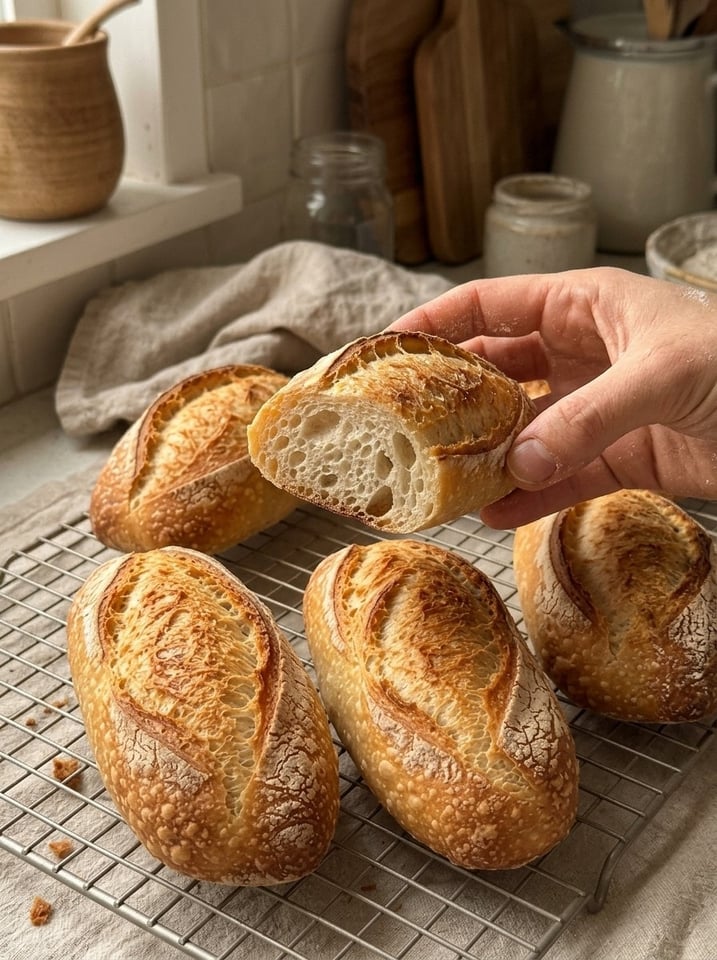
🥖✨ Sourdough Mini Baguettes: Crispy, Golden, and Naturally Delicious
SEO title: Sourdough Mini Baguettes – Crispy Golden Crust, Chewy Crumb, and Natural Tang
Meta description: Bake crispy, golden sourdough mini baguettes at home with a crackling crust, soft chewy crumb, and gentle tang. Made with an active starter and 4 ingredients. Makes 4 mini baguettes. Includes steam tips and troubleshooting.
Focus keywords: sourdough mini baguettes, sourdough baguette recipe, mini sourdough baguettes, homemade sourdough baguette, crusty sourdough bread, sourdough starter recipe, French style sourdough
These Sourdough Mini Baguettes are everything you love about classic French bread in a smaller, homemade size! 🤎 With a beautifully crisp golden crust, a soft and chewy interior, and a subtle tangy flavor from natural sourdough fermentation, these little baguettes are perfect for breakfast, sandwiches, dipping, or serving alongside your favorite soups.
Made with just a few simple ingredients, these rustic loaves develop incredible flavor through slow fermentation. When they come out of the oven, their crackling crust and irresistible fresh-bread aroma will make your kitchen feel like a French bakery! 🇫🇷🍞
A full-size baguette can be tricky to handle in a home oven. It is long, it needs careful shaping, and it often does not fit on a standard baking tray. Mini baguettes solve all of these problems. At about 10 to 12 inches (25 to 30 cm) long, they fit comfortably on a regular sheet pan, they are easier to shape and score, and they bake quickly and evenly. Better still, the smaller size means more crust per bite, which is exactly what makes a baguette so satisfying. 🥖
The recipe uses only four ingredients: bread flour, water, active sourdough starter, and salt. There is no commercial yeast, so the rise comes entirely from the natural fermentation of your starter. That slow fermentation develops flavor, improves texture, and gives the bread its gentle tang. The process takes time, but most of it is hands-off, and the stretch-and-fold method replaces traditional kneading.
In this guide, you will find the complete recipe, a detailed step-by-step walkthrough, advice on how to judge fermentation, safe steam techniques for a home oven, tips for shaping and scoring, common problems and fixes, variations, serving ideas, storage and freezing instructions, and answers to frequently asked questions. Let’s bake! 👩🍳
⏱ Recipe Overview
- ⏱ Prep Time: 30 minutes
- 🕒 Rising and Fermentation Time: 6 to 10 hours, depending on temperature and starter activity
- 🔥 Baking Time: 20 to 25 minutes
- ⏳ Total Time: Approximately 7 to 11 hours
- 🍽 Yield: 4 mini baguettes
- 🎯 Difficulty: Moderate, best for bakers who already have an active starter
🤔 Why You Will Love These Sourdough Mini Baguettes
- Crackly golden crust. A very hot oven and steam produce a thin, crisp, shattering crust. 🥖
- Chewy, airy crumb. Slow fermentation and gentle handling create a soft interior with open pockets.
- Natural sourdough flavor. The mild tang and complex flavor come from fermentation, not from additives.
- Only 4 ingredients. Bread flour, water, sourdough starter, and salt. That is all.
- Mini size. Easier to shape, score, and bake than full-length baguettes, and perfect for individual servings.
- Fits in a home oven. No special baguette pans are needed. A standard baking tray or stone is enough.
- Mostly hands-off. Stretch-and-folds replace kneading, and the fermentation does the heavy lifting.
- Flexible schedule. You can shape the loaves and refrigerate them overnight to bake whenever you like.
- Versatile. Use them for sandwiches, dipping, garlic bread, bruschetta, and more.
- Impressive results. A tray of mini baguettes looks like it came from a bakery.
🛒 Ingredients
For the Sourdough Dough
- 500 g (about 4 cups) bread flour
- 350 g (1½ cups minus 1 tablespoon) lukewarm water
- 100 g (about ⅓ cup plus 1 tablespoon) active sourdough starter, at peak activity
- 10 g (1¾ teaspoons) fine sea salt
For Shaping and Baking
- A little bread flour or rice flour, for dusting
- Ice cubes or hot water for creating steam, if your oven setup allows it safely
🧐 A Closer Look at the Ingredients
Bread flour. Bread flour has a high protein content, which helps the dough build strong gluten. That strength is essential for baguettes, which need to hold their shape and trap gas during fermentation. Weigh the flour for accuracy. At 500 g flour and 350 g water, the dough has a hydration of about 70 percent, plus the water contained in the starter.
Lukewarm water. Water at about 80 to 90°F (27 to 32°C) helps the starter get to work without overheating the dough. Warmer water speeds up fermentation, while cooler water slows it down.
Active sourdough starter at peak activity. This is the most important ingredient. Your starter should be bubbly, domed, and at or near its peak, usually 4 to 8 hours after feeding at room temperature. It should smell pleasantly yeasty and tangy. A simple test is to drop a small spoonful into water. If it floats, it is likely ready, though this is not a perfect test. A weak or sluggish starter will lead to slow fermentation and dense bread.
Fine sea salt. Salt strengthens the dough, controls fermentation, and brings out flavor. Fine salt dissolves more easily than coarse salt. Weigh the salt (10 g), since different salts measure differently by volume.
Flour for dusting. Bread flour works well. Rice flour is even better for dusting couche cloths and baking surfaces because it does not absorb moisture as easily, which helps prevent sticking.
Steam. Steam is not an ingredient, but it is crucial for a crispy crust. It keeps the surface of the dough flexible during the first part of baking, so the baguette can expand fully before the crust sets.
👩🍳 Step-by-Step Instructions
1️⃣ Mix the Dough
In a large mixing bowl, combine the lukewarm water and active sourdough starter. Stir until the starter is mostly dissolved. Add the bread flour and mix with a spoon or your hands until no dry flour remains. The dough will look rough and shaggy. Cover the bowl and let the dough rest for 30 to 45 minutes. This resting period helps the flour absorb the water and makes the dough easier to develop.
2️⃣ Add the Salt
Sprinkle the salt over the dough. With damp hands, pinch and fold the dough until the salt is evenly distributed. The dough should feel slightly sticky but manageable. Avoid adding too much extra flour, as this can make the finished baguettes dense. Keep a small bowl of water nearby to dampen your hands so the dough does not stick.
3️⃣ Stretch and Fold
Over the next 2 hours, perform 3 to 4 sets of stretch-and-folds, spacing them approximately 30 minutes apart. To do this, lift one side of the dough, stretch it gently upward, and fold it over the center. Rotate the bowl and repeat on all four sides. Cover the dough between each set. With every round, the dough should become smoother, stronger, and more elastic. By the final set, it should hold its shape slightly and feel noticeably more cohesive.
4️⃣ Let the Dough Ferment
Cover the bowl and leave the dough at room temperature until it becomes noticeably puffy, develops bubbles, and increases in volume by roughly 50 to 75 percent. This may take around 4 to 7 hours after mixing, depending on your kitchen temperature and the strength of your starter.
Tip: Follow the dough rather than the clock. A warm kitchen speeds up fermentation, while a cooler kitchen slows it down.
Signs the dough is ready: The surface looks domed and slightly jiggly, there are bubbles visible on the surface and along the sides of the bowl, the dough feels light and airy, and the edges release cleanly from the bowl when you gently pull at them.
5️⃣ Divide and Pre-Shape
Lightly flour your work surface and gently turn out the dough. Divide it into 4 equal portions, about 240 to 250 g each. Shape each portion into a short, loose log, taking care not to press out too much of the air. Cover the portions and let them rest for 15 to 20 minutes. This relaxes the gluten and makes the final shaping easier.
6️⃣ Shape the Mini Baguettes
Working with one piece at a time, gently flatten it into a small rectangle. Fold the top edge toward the center and press the seam lightly. Fold the bottom edge upward, then fold the dough in half lengthwise and seal the seam with your fingertips. Roll gently from the center outward until you have a slender baguette about 25 to 30 cm (10 to 12 inches) long. Taper the ends slightly for a classic French shape. Repeat with the remaining dough portions.
Tip: If the dough springs back while rolling, cover it and let it rest for 5 minutes before continuing. Use only as much flour as you need to prevent sticking.
7️⃣ Complete the Final Proof
Arrange the shaped baguettes seam-side down on a lightly floured couche, clean kitchen towel, or parchment-lined baking tray. If using a towel, create small folds between the loaves to help them maintain their shape. Cover loosely and let them proof for approximately 1 to 2 hours, or until they look slightly puffy and a gentle fingertip press springs back slowly. For deeper sourdough flavor, you can refrigerate the shaped baguettes overnight, provided they are covered well and monitored to prevent overproofing.
8️⃣ Preheat the Oven
Preheat your oven to 475°F (245°C) for at least 30 minutes. Place a baking stone or sturdy baking tray inside if available. A thoroughly heated baking surface helps the baguettes develop a crisp crust. Prepare a safe method for creating steam during the first part of baking. If using a separate metal tray, follow your oven’s instructions and never pour water onto a glass oven door or a hot baking stone.
9️⃣ Score the Baguettes
Carefully transfer the baguettes to parchment paper or a baking peel. Using a sharp bread lame or razor blade, make 3 to 4 shallow diagonal cuts along the top of each loaf. Hold the blade at a slight angle and use quick, confident movements. Scoring allows the bread to expand in a controlled way, creating those beautiful raised edges and rustic bakery-style appearance.
🔟 Bake Until Golden and Crispy
Slide the baguettes onto the hot baking surface. Introduce steam using your prepared, oven-safe method. Bake at 475°F (245°C) for 10 minutes, then carefully remove the steam tray if applicable and reduce the temperature to 440°F (225°C). Continue baking for another 10 to 15 minutes, until the baguettes are deeply golden and the crust feels crisp. For an extra-crusty finish, turn off the oven and leave the baguettes inside for another 3 to 5 minutes with the door slightly ajar.
Safety note: Steam causes serious burns. Wear oven mitts, keep your face and hands away from the oven opening when adding water or ice, and close the door promptly.
1️⃣1️⃣ Cool and Enjoy
Transfer the baguettes to a wire rack and let them cool for at least 20 to 30 minutes before slicing. Listen for the delicate crackling of the crust as the bread cools! The inside should be tender and chewy, with airy pockets and a gentle sourdough tang. Serve them fresh, while the crust is still wonderfully crisp. 🥖🤎
💡 Tips for Perfect Sourdough Mini Baguettes
- Use an active starter. Your starter should be bubbly, recently fed, and reliably able to rise.
- Measure by weight. A kitchen scale gives more consistent results than measuring flour by volume.
- Build gluten strength. Stretch-and-folds help the dough hold its shape and create a better crumb.
- Avoid excessive flour. Slightly tacky dough helps produce a lighter, airier loaf.
- Do not overproof. Dough that ferments too long may become weak and difficult to shape.
- Create steam early. Steam helps delay crust formation so the baguettes can expand during the initial bake.
- Score just before baking. Fresh cuts help control expansion and improve the finished appearance.
- Bake until deeply golden. A darker crust generally gives a richer flavor and a more satisfying crunch.
- Preheat thoroughly. A hot baking surface gives a strong oven spring and a crisp bottom crust.
- Handle the dough gently. Rough handling pushes out the gas that creates the open crumb.
- Use a very sharp blade. A razor blade or lame cuts cleanly without dragging the dough.
- Keep notes. Record fermentation times and temperatures so you can repeat your best results.
Common Problems and How to Fix Them
The dough is not rising. The starter may not be active enough, or the room may be too cold. Feed your starter and use it at its peak, and move the dough to a warmer spot, around 75 to 80°F (24 to 27°C).
The baguettes are flat. Overproofed dough loses its structure. Shorten the fermentation or final proof, and shape the loaves more tightly.
The crumb is dense. The dough may have been underfermented, or the gluten may not have developed enough. Allow the dough to grow by 50 to 75 percent and complete all stretch-and-fold sets.
The crust is pale. Make sure the oven and baking surface are fully preheated, and bake until the crust is deeply golden. Steam alone does not give color, so give the loaves enough time at high temperature.
The crust is too thick or tough. Too much steam for too long, or a very long bake, can create a thick crust. Remove the steam source after about 10 minutes and watch the baking time.
The baguettes spread sideways. The dough may have been too wet or the shaping too loose. Create more surface tension during shaping, and proof on a couche or towel with folds to support the sides.
The scores do not open. The blade may be dull, the loaves overproofed, or the cuts too deep or too shallow. Use a very sharp blade, make shallow cuts at a slight angle, and bake the loaves promptly after scoring.
The dough is too sticky to handle. Use damp hands rather than flour, work quickly, and chill the dough for 20 to 30 minutes if it is too soft.
The bread is too sour. Long, cold fermentation increases tang. For a milder flavor, ferment at room temperature and avoid extended refrigeration.
The bread is bland. Check your salt, allow adequate fermentation time, and bake until the crust is deeply golden.
🥖 Delicious Variations
- 🧀 Cheese mini baguettes. Fold shredded Gruyère, cheddar, or Parmesan into the dough during the last stretch-and-fold.
- 🫒 Olive baguettes. Add chopped olives for a Mediterranean twist.
- 🧄 Garlic herb. Add garlic powder and dried herbs, or brush with garlic butter after baking.
- 🌾 Whole wheat blend. Replace up to 100 g of bread flour with whole wheat flour for a nuttier flavor, and add a splash more water if needed.
- 🌱 Seeded. Brush with water and sprinkle with sesame, poppy, or sunflower seeds before baking.
- 🌿 Rosemary and sea salt. Top with fresh rosemary and flaky salt before baking.
- 🍯 Honey sourdough. Add a tablespoon of honey for a subtle sweetness and softer crust.
- 🧈 Buttery finish. Brush warm baguettes with melted butter for a softer crust and richer flavor.
- 🥖 Cold-proofed version. Shape the loaves, cover them, and refrigerate overnight for deeper flavor and easier scoring.
Delicious Ways to Serve
- 🧈 Warm with salted butter or homemade garlic herb butter.
- 🫒 Dipped in extra-virgin olive oil and balsamic vinegar.
- 🧀 Filled with cheese, tomatoes, and fresh basil.
- 🥪 Mini French-style sandwiches with ham, cheese, or roasted vegetables.
- 🍲 Alongside soups and stews, such as tomato soup, creamy vegetable soup, or hearty stews.
- 🧄 Sliced and transformed into crispy garlic bread.
- 🍅 Bruschetta. Top toasted slices with tomatoes, basil, and olive oil.
- 🧀 Cheese boards. Serve with cheeses, cured meats, olives, and fruit.
- 🍳 Breakfast. Pair with eggs, jam, or honey for a French-style breakfast.
- 🥗 With salads. Serve warm slices alongside fresh salads.
Storage and Freezing
- Room temperature: Store in a paper bag or bread box for up to 1 to 2 days.
- Refresh the crust: Reheat in a 350°F (175°C) oven for 5 to 8 minutes.
- Freeze: Once completely cooled, wrap the baguettes tightly and freeze for up to 2 to 3 months.
- Reheat from frozen: Warm in a 350 to 375°F (175 to 190°C) oven until heated through and crisp.
- Avoid plastic while warm. Do not seal freshly baked baguettes in plastic while they are still warm, as trapped moisture can soften their crust.
- Avoid the refrigerator. Refrigerating baked bread speeds up staling.
- Use leftovers. Stale baguettes make excellent croutons, breadcrumbs, French toast, or bread pudding.
📝 Nutrition Notes
Sourdough baguettes made with flour, water, starter, and salt are simple, additive-free breads. The long fermentation partially breaks down some compounds in the flour, and many people find sourdough easier to digest than bread made with commercial yeast. Serving the baguettes with protein, vegetables, and healthy fats such as olive oil makes a balanced meal. Exact nutrition values vary with portion size, so use a nutrition calculator for precise numbers.
❓ Frequently Asked Questions
How do I know if my starter is ready to use? It should be bubbly, have risen noticeably since feeding, smell pleasantly tangy, and be at or near its peak. A starter that has already collapsed is past its prime.
Can I use all-purpose flour instead of bread flour? You can, but the baguettes may be slightly less chewy and hold their shape less well. Reduce the water by 10 to 20 g to adjust.
Do I need a baking stone? No, but it helps. A sturdy, preheated baking tray also works well. The key is a hot baking surface.
Can I bake these without steam? Yes, but the crust will be less crisp and the loaves may expand less. Steam improves oven spring and crust texture.
How do I create steam safely? Place an empty metal tray on a lower rack while the oven preheats, then carefully add hot water or a few ice cubes after loading the loaves. Wear oven mitts, keep your face away, and never pour water onto a glass door or a hot stone.
Can I make the dough overnight? Yes. After shaping, cover the baguettes and refrigerate overnight. Bake them straight from the refrigerator or after a short rest at room temperature.
Why is my dough so sticky? This dough is hydrated, which creates an open crumb. Use damp hands, minimal flour, and gentle folds. The dough will become easier to handle as the gluten develops.
Can I make full-size baguettes instead? Yes. Divide the dough into 2 portions and shape each into a longer baguette, about 14 to 16 inches (35 to 40 cm). Increase the baking time by 5 to 10 minutes.
How can I get a more open crumb? Use a very active starter, ferment fully, handle the dough gently during shaping, and bake in a very hot oven with steam.
Why did my baguettes burst in unexpected places? Underproofed dough or scoring that was too shallow can cause random bursts. Allow enough proofing time and make confident, shallow cuts.
🏁 Final Thoughts
These Sourdough Mini Baguettes bring the charm of a French bakery right into your home kitchen. 🥖🇫🇷 With a crackling golden crust, a soft and chewy crumb, and the gentle tang of natural fermentation, they are everything you want from a homemade loaf in a perfectly portioned size. The process takes time, but most of it is waiting, and the result is more than worth it: a tray of crisp, aromatic baguettes that vanish almost as soon as they cool.
Whether you serve them with butter, dip them in olive oil, turn them into sandwiches, or enjoy them alongside a bowl of soup, these mini baguettes will make any meal feel special. Feed your starter, set aside a day, and enjoy the satisfaction of baking real sourdough bread. 🤎✨
📌 Save this sourdough mini baguette recipe for your next baking day! Leave a comment and tell us how yours turned out. 🥖🤎
📋 Quick Recipe Card
Sourdough Mini Baguettes
⏱ Prep: 30 minutes | 🕒 Rising and fermentation: 6 to 10 hours | 🔥 Baking: 20 to 25 minutes | ⏳ Total: Approximately 7 to 11 hours | 🍽 Yield: 4 mini baguettes
Dough: 500 g (about 4 cups) bread flour, 350 g (1½ cups minus 1 tablespoon) lukewarm water, 100 g (about ⅓ cup plus 1 tablespoon) active sourdough starter at peak activity, 10 g (1¾ teaspoons) fine sea salt.
For shaping and baking: A little bread flour or rice flour for dusting, ice cubes or hot water for creating steam if your oven setup allows it safely.
Instructions:
- Mix the water and starter, add the flour, and mix until no dry flour remains. Cover and rest 30 to 45 minutes.
- Sprinkle the salt over the dough and pinch and fold with damp hands until evenly distributed.
- Over the next 2 hours, do 3 to 4 sets of stretch-and-folds, about 30 minutes apart, covering the dough between sets.
- Cover and ferment at room temperature until puffy, bubbly, and increased in volume by about 50 to 75 percent, roughly 4 to 7 hours after mixing.
- Turn out onto a lightly floured surface, divide into 4 equal portions, shape each into a loose log, and rest 15 to 20 minutes.
- Flatten each piece into a small rectangle, fold the top edge to the center, fold the bottom edge up, fold in half lengthwise, seal the seam, and roll to 25 to 30 cm (10 to 12 inches) with tapered ends.
- Proof seam-side down on a floured couche, towel, or parchment-lined tray for 1 to 2 hours until slightly puffy and a gentle press springs back slowly. Optionally refrigerate overnight, covered.
- Preheat the oven to 475°F (245°C) for at least 30 minutes with a stone or sturdy tray inside, and prepare a safe steam method.
- Score each baguette with 3 to 4 shallow diagonal cuts.
- Bake on the hot surface with steam at 475°F (245°C) for 10 minutes, then remove the steam tray, reduce to 440°F (225°C), and bake 10 to 15 minutes more until deeply golden and crisp. For extra crust, leave in the switched-off oven with the door slightly ajar for 3 to 5 minutes.
- Cool on a wire rack for at least 20 to 30 minutes before slicing.

Sourdough Mini Baguettes
Ingredients
For the Sourdough Dough
- 500 g (about 4 cups) bread flour
- 350 g (1½ cups minus 1 tablespoon) lukewarm water
- 100 g (about ⅓ cup plus 1 tablespoon) active sourdough starter, at peak activity
- 10 g (1¾ teaspoons) fine sea salt
For Shaping and Baking
- A little bread flour or rice flour, for dusting
- Ice cubes or hot water for creating steam, if your oven setup allows it safely
🧐 A Closer Look at the Ingredients
Bread flour. Bread flour has a high protein content, which helps the dough build strong gluten. That strength is essential for baguettes, which need to hold their shape and trap gas during fermentation. Weigh the flour for accuracy. At 500 g flour and 350 g water, the dough has a hydration of about 70 percent, plus the water contained in the starter.
Lukewarm water. Water at about 80 to 90°F (27 to 32°C) helps the starter get to work without overheating the dough. Warmer water speeds up fermentation, while cooler water slows it down.
Active sourdough starter at peak activity. This is the most important ingredient. Your starter should be bubbly, domed, and at or near its peak, usually 4 to 8 hours after feeding at room temperature. It should smell pleasantly yeasty and tangy. A simple test is to drop a small spoonful into water. If it floats, it is likely ready, though this is not a perfect test. A weak or sluggish starter will lead to slow fermentation and dense bread.
Fine sea salt. Salt strengthens the dough, controls fermentation, and brings out flavor. Fine salt dissolves more easily than coarse salt. Weigh the salt (10 g), since different salts measure differently by volume.
Flour for dusting. Bread flour works well. Rice flour is even better for dusting couche cloths and baking surfaces because it does not absorb moisture as easily, which helps prevent sticking.
Steam. Steam is not an ingredient, but it is crucial for a crispy crust. It keeps the surface of the dough flexible during the first part of baking, so the baguette can expand fully before the crust sets.
Instructions
In a large mixing bowl, combine the lukewarm water and active sourdough starter. Stir until the starter is mostly dissolved. Add the bread flour and mix with a spoon or your hands until no dry flour remains. The dough will look rough and shaggy. Cover the bowl and let the dough rest for 30 to 45 minutes. This resting period helps the flour absorb the water and makes the dough easier to develop.
Sprinkle the salt over the dough. With damp hands, pinch and fold the dough until the salt is evenly distributed. The dough should feel slightly sticky but manageable. Avoid adding too much extra flour, as this can make the finished baguettes dense. Keep a small bowl of water nearby to dampen your hands so the dough does not stick.
Over the next 2 hours, perform 3 to 4 sets of stretch-and-folds, spacing them approximately 30 minutes apart. To do this, lift one side of the dough, stretch it gently upward, and fold it over the center. Rotate the bowl and repeat on all four sides. Cover the dough between each set. With every round, the dough should become smoother, stronger, and more elastic. By the final set, it should hold its shape slightly and feel noticeably more cohesive.
Cover the bowl and leave the dough at room temperature until it becomes noticeably puffy, develops bubbles, and increases in volume by roughly 50 to 75 percent. This may take around 4 to 7 hours after mixing, depending on your kitchen temperature and the strength of your starter.
Tip: Follow the dough rather than the clock. A warm kitchen speeds up fermentation, while a cooler kitchen slows it down.
Signs the dough is ready: The surface looks domed and slightly jiggly, there are bubbles visible on the surface and along the sides of the bowl, the dough feels light and airy, and the edges release cleanly from the bowl when you gently pull at them.
Lightly flour your work surface and gently turn out the dough. Divide it into 4 equal portions, about 240 to 250 g each. Shape each portion into a short, loose log, taking care not to press out too much of the air. Cover the portions and let them rest for 15 to 20 minutes. This relaxes the gluten and makes the final shaping easier.
Working with one piece at a time, gently flatten it into a small rectangle. Fold the top edge toward the center and press the seam lightly. Fold the bottom edge upward, then fold the dough in half lengthwise and seal the seam with your fingertips. Roll gently from the center outward until you have a slender baguette about 25 to 30 cm (10 to 12 inches) long. Taper the ends slightly for a classic French shape. Repeat with the remaining dough portions.
Tip: If the dough springs back while rolling, cover it and let it rest for 5 minutes before continuing. Use only as much flour as you need to prevent sticking.
Arrange the shaped baguettes seam-side down on a lightly floured couche, clean kitchen towel, or parchment-lined baking tray. If using a towel, create small folds between the loaves to help them maintain their shape. Cover loosely and let them proof for approximately 1 to 2 hours, or until they look slightly puffy and a gentle fingertip press springs back slowly. For deeper sourdough flavor, you can refrigerate the shaped baguettes overnight, provided they are covered well and monitored to prevent overproofing.
Preheat your oven to 475°F (245°C) for at least 30 minutes. Place a baking stone or sturdy baking tray inside if available. A thoroughly heated baking surface helps the baguettes develop a crisp crust. Prepare a safe method for creating steam during the first part of baking. If using a separate metal tray, follow your oven’s instructions and never pour water onto a glass oven door or a hot baking stone.
Carefully transfer the baguettes to parchment paper or a baking peel. Using a sharp bread lame or razor blade, make 3 to 4 shallow diagonal cuts along the top of each loaf. Hold the blade at a slight angle and use quick, confident movements. Scoring allows the bread to expand in a controlled way, creating those beautiful raised edges and rustic bakery-style appearance.
Slide the baguettes onto the hot baking surface. Introduce steam using your prepared, oven-safe method. Bake at 475°F (245°C) for 10 minutes, then carefully remove the steam tray if applicable and reduce the temperature to 440°F (225°C). Continue baking for another 10 to 15 minutes, until the baguettes are deeply golden and the crust feels crisp. For an extra-crusty finish, turn off the oven and leave the baguettes inside for another 3 to 5 minutes with the door slightly ajar.
Safety note: Steam causes serious burns. Wear oven mitts, keep your face and hands away from the oven opening when adding water or ice, and close the door promptly.
Transfer the baguettes to a wire rack and let them cool for at least 20 to 30 minutes before slicing. Listen for the delicate crackling of the crust as the bread cools! The inside should be tender and chewy, with airy pockets and a gentle sourdough tang. Serve them fresh, while the crust is still wonderfully crisp. 🥖🤎